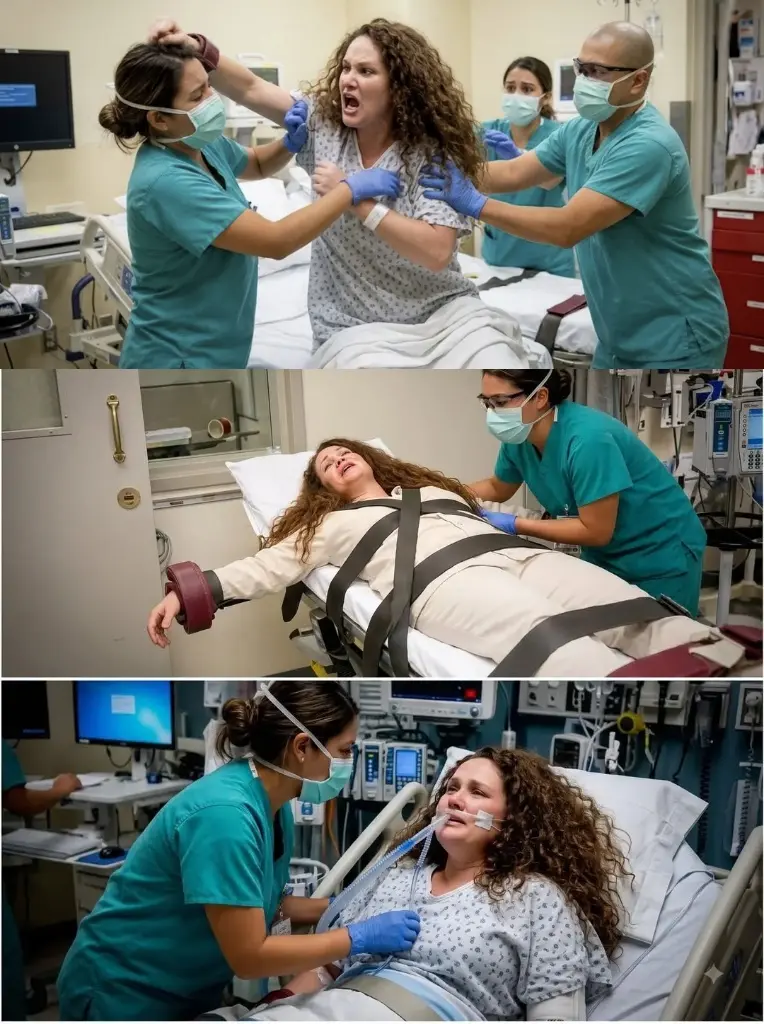
🚨⚖️ CHRISTA PIKE REGAINS CONSCIOUSNESS AFTER SURVIVING TENNESSEE’S FAILED EXECUTION — AND WHAT SHE REMEMBERS COULD BECOME PART OF AN EXTRAORDINARY LEGAL BATTLE
NASHVILLE, TENNESSEE — Christa Pike is alive, conscious and speaking after Tennessee attempted to execute her by lethal injection on September 30, 2026 — a development that has transformed an already extraordinary case into a major legal and procedural controversy. Pike, 50, survived after the state administered two doses of pentobarbital at Riverbend Maximum Security Institution. She was rushed to a hospital unconscious, placed on a ventilator and initially faced an uncertain prognosis. Then, nearly a week later, her attorneys announced that she had regained consciousness and begun speaking. She reportedly awoke confused and asked where she was. Pike has since left the hospital and returned to prison, but the questions surrounding what happened inside the execution chamber are only becoming more serious: What went wrong with the lethal injection? What does Pike remember? And could her firsthand account become evidence if Tennessee ever attempts to execute her again?
To understand the magnitude of the situation, it is important to separate what has been confirmed from what remains disputed.
Pike was sentenced to death for the 1995 killing of 19-year-old Colleen Slemmer. After decades of appeals, Tennessee scheduled Pike’s execution for September 30.
The state intended to kill her using pentobarbital.
Instead, the execution failed.
The Tennessee Department of Correction has maintained that personnel followed every step of the state’s established execution protocol. The department acknowledged that the protocol did not authorize additional procedures beyond those performed that evening and confirmed that Pike was transported to an outside medical facility.
But Pike’s attorneys have offered a dramatically different picture of what occurred inside the chamber.
A newly filed declaration from attorney Randy Spivey, who witnessed the execution attempt, describes prolonged difficulty establishing the intravenous lines required to administer the drug.
According to Spivey, members of the IV team appeared to use approximately 10 needles while trying multiple locations on Pike’s arms.
At one point, members of the execution team reportedly expressed concern that veins in her left arm might have “blown.”
Pike complained that her arm was burning and felt as though it might burst, according to the filing.
Her breathing subsequently became increasingly labored.
Spivey described hearing snoring and choking sounds as the process continued. Eventually, he said, Pike was still alive after two doses had been administered — and Tennessee’s protocol did not authorize a third.
Then came the emergency response.
At approximately 8:40 p.m., according to a released transcript, someone at the prison called 911 requesting an ambulance.
Pike was taken from the prison alive.
The execution had failed.
The physical aftermath was severe.
Her attorneys initially reported that Pike was unconscious and intubated, with both arms swollen, burned and blistered. She required ventilator support while hospital personnel worked to treat her after the execution attempt.
For days, her future remained uncertain.
Then, on October 6, came the development few expected.
Pike woke up.
Her attorney said she was confused and reportedly asked, “Where am I?” after regaining consciousness. Her lawyers described her recovery as medically extraordinary, although they cautioned that she faced a long road ahead.
The early medical picture remained serious.
Her attorneys subsequently reported that Pike developed pneumonia and a blood clot and initially could not swallow or move her arms and hands. She also experienced problems with concentration and memory.
But her condition improved.
Within days, attorneys said she was taking assisted steps, eating regular food and recovering movement and strength in her arms. On October 10, Pike was discharged from the hospital and returned to the Debra K. Johnson Rehabilitation Center, where she had previously been incarcerated.
That does not mean the medical questions are finished.
Nor does it mean Pike can already provide a complete, reliable account of everything she experienced.
Her attorneys reported cognitive confusion after she regained consciousness, making it particularly important not to invent dramatic quotations or supposed memories from the execution chamber.
But if Pike eventually provides a detailed firsthand account, what she remembers could become relevant to the litigation surrounding the failed execution.
And evidence from that night is already being protected.
A Tennessee judge granted Pike’s legal team’s request requiring the state to preserve evidence connected to the September 30 attempt.
The preservation order covers potentially critical material, including drugs, syringes, IV equipment, photographs, video and audio recordings, witness accounts, emails and documentation concerning complications or equipment problems.
That order could become enormously significant.
Because the central question is no longer whether something went wrong.
Pike survived.
The deeper question is why.
Was the pentobarbital delivered properly into her bloodstream?
Did an IV line fail?
Did some of the drug enter surrounding tissue instead?
Were there problems with training, equipment or supervision?
And were warning signs visible before officials administered additional medication?
Those questions are now being examined against an increasingly detailed eyewitness account.
Medical experts reviewing descriptions of the procedure have focused heavily on the IV process and the possibility that the drug did not enter Pike’s bloodstream as intended. Recent reporting has highlighted expert criticism of the execution team’s practices, although Tennessee’s official independent review remains crucial to determining exactly what occurred.
The consequences have already extended far beyond Pike herself.
Tennessee Governor Bill Lee halted additional executions and ordered an independent review of the failed procedure. The state’s prison commissioner subsequently resigned.
That means the September 30 attempt is no longer merely an individual death-row case.
It has become a test of Tennessee’s execution system.
Then comes perhaps the most difficult legal question of all:
Can Tennessee attempt to execute Christa Pike again?
There is no simple answer yet.
Her attorneys argue that she should never be subjected to another execution attempt and have urged Governor Lee to commute her sentence to life imprisonment without parole.
Any future effort to carry out the death sentence could produce substantial litigation over the Eighth Amendment’s prohibition against cruel and unusual punishment, particularly given the injuries Pike allegedly suffered during the first attempt.
Legal experts have expressed differing views about whether the Constitution would ultimately prevent Tennessee from trying again.
Pike’s own recollection could potentially become part of that litigation.
If she remembers experiencing severe pain while remaining conscious, her lawyers could seek to incorporate those details into future claims.
If medical records establish injuries consistent with drug infiltration or IV failure, those records could become important evidence.
If recordings or witness testimony contradict the state’s account of protocol compliance, those discrepancies could also matter.
But each of those possibilities must be established through evidence.
Pike’s survival should not become an invitation to manufacture memories for her.
That distinction matters especially because the case involves two separate human realities.
Pike’s experience during the failed execution raises serious constitutional, medical and governmental questions.
But the reason she was on death row must not disappear from the story.
Pike was convicted and sentenced to death for the 1995 killing of Colleen Slemmer, a 19-year-old fellow student. Slemmer’s family has lived with the consequences of that crime for more than three decades.
Scrutiny of how the government carries out punishment does not erase the victim.
Nor does the severity of Pike’s crime eliminate the government’s obligation to follow constitutional and lawful procedures.
Both realities exist simultaneously.
That is what makes this case so difficult.
The state intended September 30 to mark the end of Christa Pike’s legal story.
Instead, it created an entirely new chapter.
Pike survived.
She lost consciousness.
She spent days on a ventilator.
Then she woke up.
Now she is back in prison while attorneys, medical experts, courts and state officials examine what happened during the hours when Tennessee attempted to end her life.
And perhaps the most consequential witness to those events may eventually be Pike herself.
What does she remember?
How much was she conscious for?
What did she feel?
What did she hear?
Those questions are compelling.
But they should not be answered by speculation.
The medical records, preserved evidence, eyewitness testimony, independent investigation — and, if she is able to provide it reliably, Pike’s own account — will have to tell that story.
Because after an execution that was supposed to end everything instead left the condemned prisoner alive, Tennessee now faces a question far larger than what happened on September 30:
What happens next?
DISCLAIMER: Christa Pike was convicted and sentenced to death for the 1995 murder of 19-year-old Colleen Slemmer. Tennessee attempted to execute Pike by lethal injection on September 30, 2026, but she survived after receiving two doses of pentobarbital and was hospitalized. Her attorneys subsequently confirmed that she regained consciousness and was speaking, and she has since been discharged from the hospital and returned to prison. Accounts describing IV difficulties, pain and other alleged procedural problems come largely from Pike’s attorneys, witnesses and court filings; Tennessee’s Department of Correction has stated that it followed the established execution protocol. An independent review is underway. This article does not claim that Pike has provided a complete firsthand account of the execution attempt or that another execution has been legally authorized or prohibited. Photographs displayed are illustrative unless specifically identified as documenting the September 30 events.
Add a clear Facebook call to action